×

How subscription works

1
Choose Your Plan

Select the quantity of packs you need each cycle.

2
Select Your Frequency

Set how often you would like them delivered.

3
Save every cycle

Enjoy exclusive savings on every subscription order.

4
Automated delivery

Your packs arrive at your doorstep, right when you need them.

5
Pause or cancel anytime

You will be charged automatically each month but you're in control, always.

×
10% OFF!
Say hello to your new favorite pad. Sign up and get 10% off your first order! Join our community <3
+91
Join Papaya!
×
FIRST10!
Use this code at checkout!
Copy coupon code
Why Heavy Flow Needs Better Pad Technology – Papaya Blood-Solidifying Pads Skip to content
Why Heavy Flow Needs Better Pad Technology

Why Heavy Flow Needs Better Pad Technology

If you have a heavy period, you know the routine: the thickest pad on the shelf, changed more often than the label recommends, and still an occasional leak at the worst possible moment. It can feel like nothing is actually built for you.

Most pads aren't. The standard approach to heavy flow has always been simple, add more absorbent material, make a bigger pad. But volume alone doesn't determine how a heavy flow pad performs. The engineering inside does.

The Problem with More Pulp 

Most conventional pads use wood-fluff pulp or SAPs as the absorbent core. It's cheap, widely available, and works up to a point. Add more of it for heavier flow and specific problems follow.

A thicker pulp core absorbs by soaking fluid into a mass of fibres. Under body weight and movement, that saturated mass compresses, and compressed saturated pulp pushes fluid back toward the surface. More pulp means more fluid sitting near your skin, not less. SAPs although perform well, they are still 100% plastic meaning exposure to chemicals and microplastics for hours on end. 

Thick pads also move. They bunch between the thighs and shift out of position, a real and underacknowledged cause of leaks. Not because the pad ran out of capacity, but because coverage ended up somewhere it shouldn't have.

And a thick pad is, by definition, more noticeable. For people with heavy flow who wear pads for extended stretches or overnight, that bulk is a real discomfort, not a minor one.

What Heavy Flow Actually Requires

Managing heavy flow well means a pad that absorbs fast enough that fluid doesn't pool and run to the edges before the core takes it in. It means locking fluid in place so it doesn't rewet the surface or shift under pressure. It means distributing fluid evenly so no single zone saturates while the rest sits unused. And it means doing all of that without becoming so thick and rigid that it loses coverage or comfort.

That's a materials problem. Not a sizing problem.

Coagulation Technology

The most meaningful shift in heavy flow pad design is coagulation technology developed at Papaya, a mechanism that converts absorbed fluid into a stable gel structure rather than leaving it as liquid sitting in saturated fibres.

When menstrual fluid contacts the core, coagulation agents react with it to form a semi-solid gel. This gel doesn't shift, doesn't compress back to the surface, and doesn't release fluid when the pad is pressed. Once fluid gels, it stays gelled.

For heavy flow users, that translates into less rewet, since gelled fluid doesn't return to the top sheet and the surface stays drier; better use of capacity, because the gel spreads more evenly through the core instead of saturating a central zone; more consistent leak protection, since fluid locked in position doesn't migrate toward the edges under pressure, which is the main mechanism behind side leaks; and thinner construction becomes possible, because the pad no longer needs bulk to hold fluid.

Ultra Thin Doesn't Mean Less Protection

There's a persistent assumption that ultra thin pads must perform worse on heavy days. Thinner feels like less. It isn't, when the underlying technology is right.

Ultra thin pads built on our patented coagulation-based cores can outperform much thicker conventional pads on heavy flow, because their performance comes from chemistry and structure rather than the sheer quantity of material in them. The fluid is locked in a gel instead of sitting in a saturated pulp mass waiting to rewet, bunch, or leak.

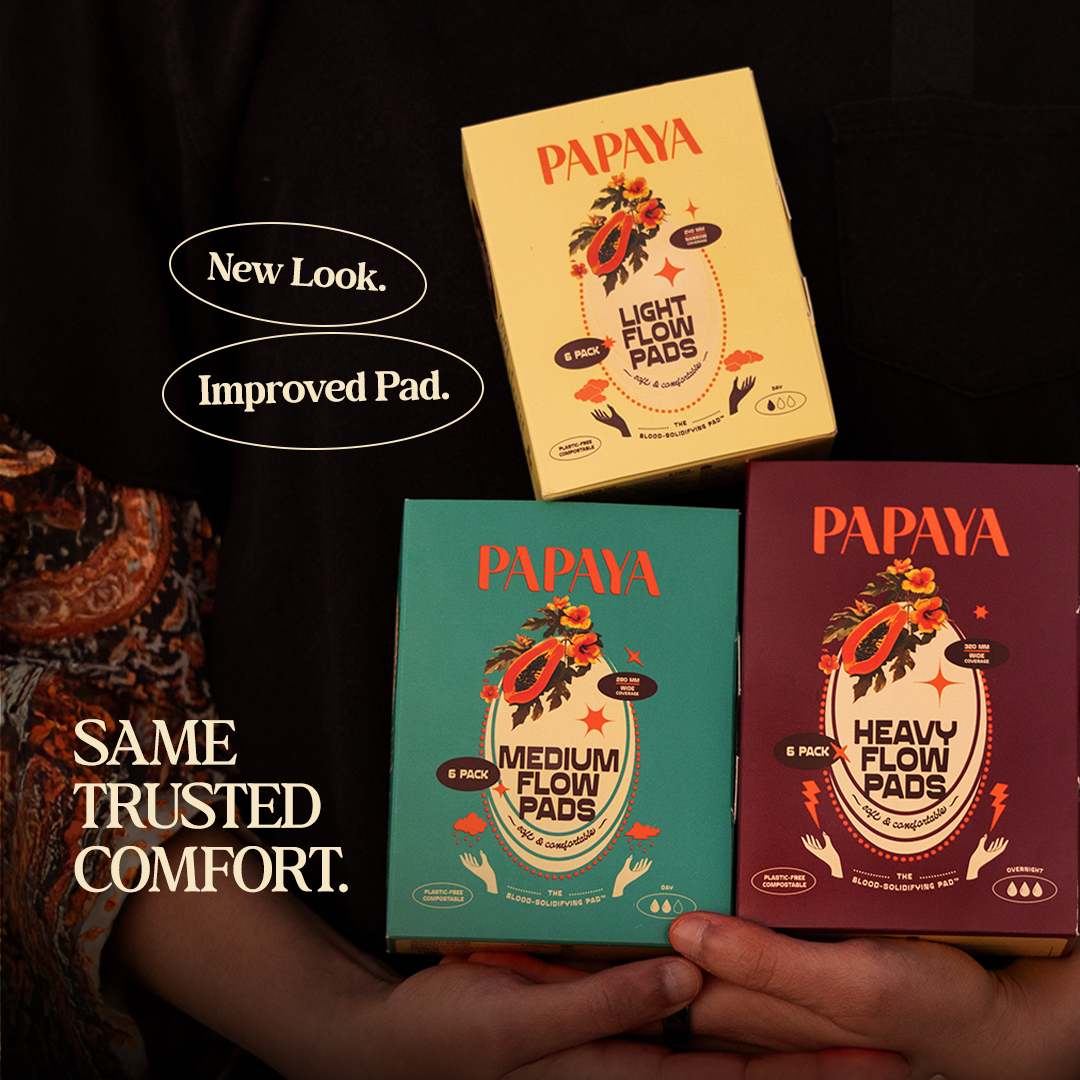
Papaya's heavy flow pads are built on this principle. More protection doesn't require more bulk.

Leaks are Usually an Engineering Failure

If you're getting leaks with the pads you use, the problem is almost certainly the pad, not how you're wearing it or how heavy your flow happens to be.

Leaks come down to three specific causes: flow rate outpacing the pad's uptake speed, so fluid runs to the edges before it's absorbed; saturated pulp releasing fluid under compression and that fluid migrating to the perimeter; or the pad shifting so coverage no longer lines up with flow.

Good heavy flow technology addresses all three at once: faster uptake, coagulation to stop rewet and migration, and a design that actually holds position.

What to Actually Look for

"Extra absorbency" on the packaging tells you very little on its own. Better questions: does the pad use run of the mill absorption? Is the construction built to hold position during movement? Does the brand make specific, checkable claims about leak protection rather than vague ones?

Heavy flow deserves pads engineered for the actual problem, not just scaled-up versions of ones that were never solving it.

Previous Post Next Post