×

How subscription works

1
Choose Your Plan

Select the quantity of packs you need each cycle.

2
Select Your Frequency

Set how often you would like them delivered.

3
Save every cycle

Enjoy exclusive savings on every subscription order.

4
Automated delivery

Your packs arrive at your doorstep, right when you need them.

5
Pause or cancel anytime

You will be charged automatically each month but you're in control, always.

×
10% OFF!
Say hello to your new favorite pad. Sign up and get 10% off your first order! Join our community <3
+91
Join Papaya!
×
FIRST10!
Use this code at checkout!
Copy coupon code
The Hidden Materials Inside Your Menstrual Pad – Papaya Blood-Solidifying Pads Skip to content
The Hidden Materials Inside Your Menstrual Pad

The Hidden Materials Inside Your Menstrual Pad

Pick up a pack of sanitary pads at any store and read the packaging. You'll find flow ratings, wing configurations, and a long list of freshness claims. What you probably won't find is a full materials list.

Most menstrual pads aren't required to disclose their complete ingredient composition.

For most of the history of modern period care, that has meant wearing a product against some of the most sensitive skin on the body without knowing what it's actually made of.

Here's what's typically inside.


The Top Sheet

This is the layer touching your skin. In most mainstream pads it's a nonwoven fabric made from synthetic polymers like polypropylene or polyethylene fibres bonded together rather than woven. These materials pass fluid through and cost little to manufacture. They're not breathable, they generate friction, and they offer no particular advantage for skin contact. Some pads use a perforated film top sheet instead, which creates a dry feel but breathes even less than nonwoven fabric.

Soft cotton pads use a cotton or cotton-blend top sheet. Cotton transmits moisture vapour better and creates far less friction against skin, which is why sensitive-skin and hypoallergenic pads consistently favour it. 

The Acquisition and Distribution Layer

Below the top sheet, many pads add a secondary layer built to move fluid quickly from the top sheet to the absorbent core. It's typically a lightly bonded nonwoven made from synthetic fibres, and its job is speed. It works on getting fluid away from the skin surface before it can rewet upward.

The Absorbent Core

This is where most of a pad's capacity sits. Most conventional pads use wood-fluff pulp, which absorbs by soaking fluid into the fibre structure the way a sponge does. Under pressure that saturated pulp can push fluid back up, which is why the wet feeling persists even after the pad has technically absorbed your flow.

Some pads use super absorbent polymer crystals instead, usually sodium polyacrylate, which can absorb many times their own weight and gel on contact. It's the same technology used in disposable nappies. SAPs improve capacity substantially and stop rewet. But they're synthetic, petroleum-derived, and non-biodegradable and there's evidence linking them to skin irritation and endocrine disruption.

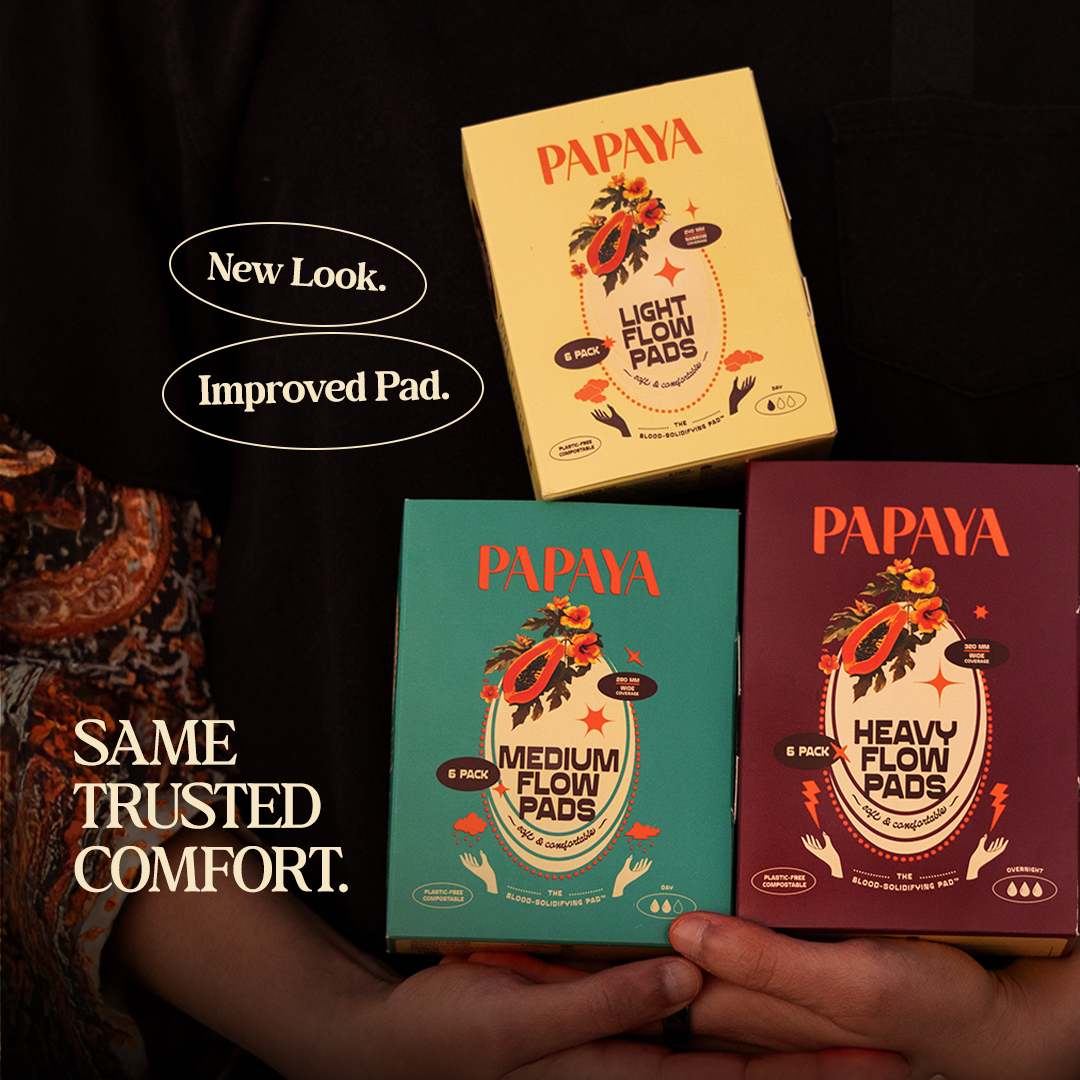
Papaya took a different route. The absorption mechanism that most pads rely on hasn't changed in decades and underperforms by design, so Papaya focused on how fluid gets handled rather than how much fiber can hold it. In place of SAPs, Papaya pads use a patented natural biocoagulant in the core. Rather than absorbing fluid into a polymer crystal, the biocoagulant draws on blood's own ability to clot, causing menstrual blood to solidify inside the pad into a stable structure that stays dry to the touch, doesn't rewet under pressure, and needs no synthetic chemistry to hold. The core also uses cellulose, a plant-derived material, in place of plastic-laced alternatives.

The Diffusion Layer

Some designs add a layer between the core and the backsheet to spread fluid laterally through the core, improving how much of the capacity actually gets used. It matters for preventing the wet-centre, dry-edges failure common in cheaper pads.

The Backsheet

The bottom of the pad, facing your underwear, exists to prevent leakage. In most pads this is a solid polyethylene film which is effective at stopping leaks, completely impermeable to heat and moisture vapour, and entirely non-biodegradable.

The Adhesive Strip

The sticky strip that holds the pad in your underwear is a hotmelt adhesive, a synthetic polymer applied in patterns. It's generally considered inert, but it still exposes skin to some chemical load where it contacts the pad's edge. It's an easy detail to overlook given how little direct skin contact it has, but it's still a piece of the pad worth accounting for.

The Chemicals You Don't See Listed

Beyond the structural layers, conventional pads often carry processing chemicals that never make it onto the label.

Chlorine bleaching agents whiten wood pulp cores, and the process can leave trace dioxin or furan residue behind. Many brands now use elemental chlorine-free or totally chlorine-free processes, but they rarely tell consumers this.

Synthetic fragrances get added to mask period odour, and phthalates used in fragrance compounds are known endocrine disruptors that can affect hormonal and reproductive health.

Other chemicals turn up too, VOCs, brighteners, and similar additives that carry their own toxicity and hormone-disruption risks, on top of the microplastics a plastic pad body sheds into the body over time.

Papaya built around these problems directly. Once the biocoagulant replaced absorption as the core mechanism, the next step was making sure the rest of the pad matched: no toxins, no plastic, sustainable materials throughout. The pad body is entirely biodegradable, and nothing in production uses fragrance or bleach. The top sheet is organic cotton and cellulose based with increased breathability and 100% biodegradable and so is the back sheet.

Why This Information is Hard to Find

The lack of mandatory ingredient labelling reflects a regulatory gap, not a safety guarantee. In most countries menstrual products sit somewhere between cosmetics and medical devices, a grey zone that has historically meant less disclosure than either category would otherwise require.

Consumer advocacy has been pushing for change, and some brands have adopted voluntary transparency. Papaya publishes exactly what its pads are made of: organic cotton, cellulose, a natural biocoagulant, and a biodegradable backsheet. No plastics, no fragrances, no hidden chemistry.

What to Look For

A complete materials list isn't always available, but a few signals help. Does the top sheet specify cotton or a cotton-feel material? Is the pad explicitly fragrance-free? Does the brand mention chlorine-free processing? Is coagulation or SAP-based absorption named specifically, rather than just "high absorbency"? Does the backsheet claim breathability, and is it actually plastic-free?

A pad contacts sensitive skin for hours a day, for years. Knowing what's in it isn't overcaution.

Previous Post Next Post