×

How subscription works

1
Choose Your Plan

Select the quantity of packs you need each cycle.

2
Select Your Frequency

Set how often you would like them delivered.

3
Save every cycle

Enjoy exclusive savings on every subscription order.

4
Automated delivery

Your packs arrive at your doorstep, right when you need them.

5
Pause or cancel anytime

You will be charged automatically each month but you're in control, always.

×
10% OFF!
Say hello to your new favorite pad. Sign up and get 10% off your first order! Join our community <3
+91
Join Papaya!
×
FIRST10!
Use this code at checkout!
Copy coupon code
The Science of Breathability in Pads – Papaya Blood-Solidifying Pads Skip to content

The Science of Breathability in Pads

We're told to wear breathable underwear for summer heat and monsoon humidity. What gets less attention is that the same logic applies to the pad sitting against your skin for hours at a stretch.

Why Moisture Accumulates

During your period, moisture comes from two sources: menstrual flow and sweat. Your vulva carries a high concentration of sweat glands. Cover it with clothing and a pad for several hours and you get a warm, enclosed environment. Even on light days, moisture builds up.

A pad's job isn't only absorption. It's moisture management, moving fluid away from skin fast enough that it doesn't sit there. When it fails at that, you get dampness, and with it, friction and skin breakdown.

What the Top Sheet Actually Does

The layer of a pad that touches your skin is the top sheet. It has to pass fluid through quickly, resist rewet, allow air circulation, and stay soft enough to keep friction down. That's a lot to ask of one layer of material.

Conventional pads typically use a nonwoven synthetic top sheet made with polypropylene or polyethylene fibres bonded together. These move fluid downward well enough, but they don't breathe. Heat and vapour get trapped underneath. That sticky, humid feeling gets worse the longer you wear the pad, not better.

Cotton top sheets behave differently. Cotton fibres are inherently breathable, letting air and vapour pass through more freely than dense synthetic nonwovens allow. It's the same reason cotton underwear gets recommended for intimate health so consistently. The physics carries over directly to a pad's top layer.

At Papaya, the top sheet is organic cotton, chosen because skin contact matters. A synthetic top sheet that traps heat and moisture works against everything else the pad is trying to do.

What "Breathable" Actually Means in Materials Terms

In materials science, breathability gets measured by moisture vapour transmission rate, or MVTR which means how much water vapour passes through a material over a given time. Cotton scores considerably better on MVTR than dense synthetic nonwovens do.

The backsheet, the bottom layer that stops leakage, affects breathability too. Many conventional pads use solid plastic film there. Better-designed pads use a microporous film instead: pores small enough that liquid can't pass through, but vapour can. You get leak protection without turning the pad into a sealed plastic layer against your body.

When a pad isn't breathable, the sequence tends to run the same way. Moisture from flow and sweat builds up between skin and pad. Heat accumulates because vapour has nowhere to go. The skin surface stays wet. Repeated wetting and friction wear down the skin barrier. Irritation, chafing, and rashes follow.

This is why breathability matters beyond comfort. A lot of what gets blamed on "sensitive skin" or poor hygiene is actually the predictable outcome of bad moisture management in the pad itself.

Coagulation Technology: A Different Approach to Absorption

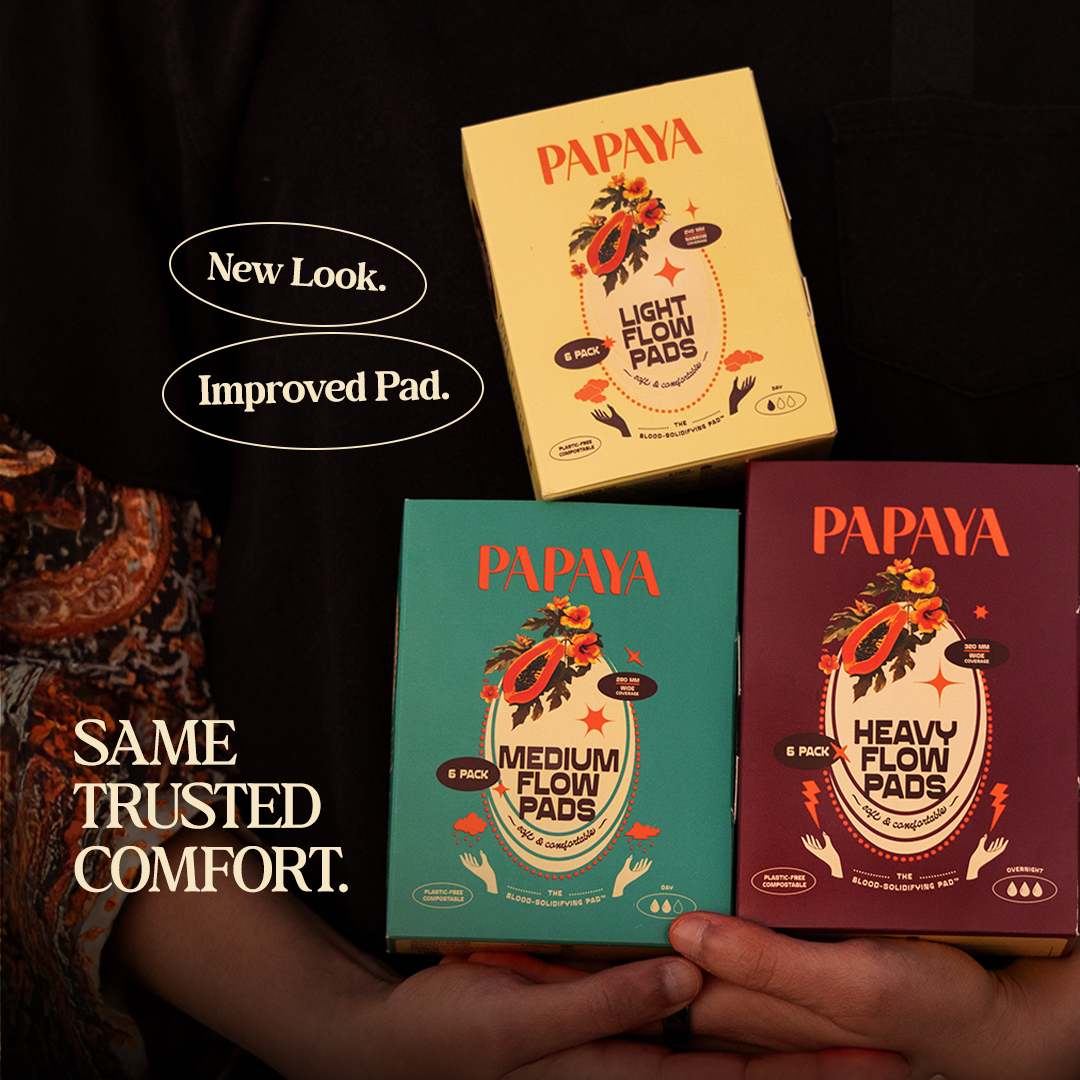
Papaya tackled this from the absorption side. Most pads absorb fluid into a mass of wet glob. This saturated glob stays wet and keeps the skin around it wet throughout the day.

Papaya's coagulation-based core works differently. When menstrual fluid contacts the core, coagulation agents react with it to form a stable gel. Gelled fluid doesn't shift, doesn't compress back to the surface, and doesn't release when the pad is pressed. Once it's locked in, it stays locked in. The gel formation also means it is no longer as wet hence cutting down on the wet icky feeling and irritation.

That directly cuts the repeated wetting behind most of the discomfort people associate with wearing pads for hours. The surface stays drier not just in the first hour, but consistently through the day.

The Practical Difference

A pad with a cotton top sheet, a microporous backsheet, and a coagulation-based core feels different from a conventional synthetic pad. Not because of what the packaging says. Because the materials are doing different jobs. 

If you've assumed that feeling damp during your period is just how it goes, the pad you're using might be the variable worth changing.

Previous Post Next Post