×

How subscription works

1
Choose Your Plan

Select the quantity of packs you need each cycle.

2
Select Your Frequency

Set how often you would like them delivered.

3
Save every cycle

Enjoy exclusive savings on every subscription order.

4
Automated delivery

Your packs arrive at your doorstep, right when you need them.

5
Pause or cancel anytime

You will be charged automatically each month but you're in control, always.

×
10% OFF!
Say hello to your new favorite pad. Sign up and get 10% off your first order! Join our community <3
+91
Join Papaya!
×
FIRST10!
Use this code at checkout!
Copy coupon code
Why Plastic-Free Period Care Matters – Papaya Blood-Solidifying Pads Skip to content
Why Plastic-Free Period Care Matters

Why Plastic-Free Period Care Matters

When people think about plastic pollution, they picture water bottles and packaging. Period products rarely come up in that conversation. They should.

The average sanitary pad is roughly 90% plastic, and tens of billions get discarded every year. The environmental case against period products is clear enough. There's a second case, less discussed, about what all that plastic means for the person wearing it.

What wearing plastic pads really feels like:

What "Plastic-free" Actually Means in a Pad

A generic menstrual pad has plastic in nearly every layer. A polypropylene or polyethylene nonwoven top sheet. A solid polyethylene backsheet. Polyethylene wings. A synthetic nonwoven acquisition layer. Individual polyethylene wrappers. A plastic outer bag. Even the absorbent core often runs on superabsorbent polymer crystals, which are synthetic and petroleum-derived.

When you read "organic cotton pads" or "natural pads" on packaging, check whether only the top sheet changed. Many products swap out the single layer touching your skin while keeping a polyethylene backsheet, synthetic adhesive, and plastic wrapper. The overall plastic content barely moves.

Genuinely plastic-free period products require rethinking materials across the entire product, not one layer of it. Pads like Papaya have no plastic anywhere: organic cotton and cellulose for the top layers, a natural biocoagulant in the core, a biodegradable backsheet instead of polyethylene. No microplastics, no landfill plastic, no synthetic polymer chemistry anywhere in the construction.

The Health Case 

Plastics aren't inert. Manufacturing and degradation involve plasticisers, stabilisers, and breakdown products, some of them endocrine-disrupting chemicals that affect hormones and reproductive health. Bisphenol A, phthalates, and dioxins from chlorine bleaching have all turned up in studies of period product composition as hormone disruptors.

The vulvar area absorbs substances more readily than most skin. Brief contact with a material that releases trace chemicals is one thing. Wearing a pad for six to eight hours, several days a month, for decades, is a different exposure profile entirely.

The regulatory baseline of "approved and safe" is a low bar. Papaya works to a different one: nothing in the pad that has no business being near the body's most hormonally sensitive tissue.

The Environmental Case 

In India alone, an estimated 12 billion menstrual products get discarded every year. Most end up in landfill or in unmanaged waste streams. In many parts of the world, period product waste gets burned, releasing dioxins and other toxins into the air.

Period products can't be easily recycled as the composite multi-material construction and the biological contamination rule that out. There's no mainstream infrastructure for processing them, and every conventional pad ever made still exists somewhere, given a roughly 500-year lifespan.

Biodegradable pads like Papaya's break down in approximately 180 to 240 days under composting conditions. They also break down in landfill settings, degrading even when simply buried in soil without controlled composting conditions. That matters because most period product waste ends up in landfill, not in compost facilities built for decomposition. A product that only biodegrades under ideal industrial conditions isn't solving the actual disposal problem.

What Plastic-free Looks Like in Practice

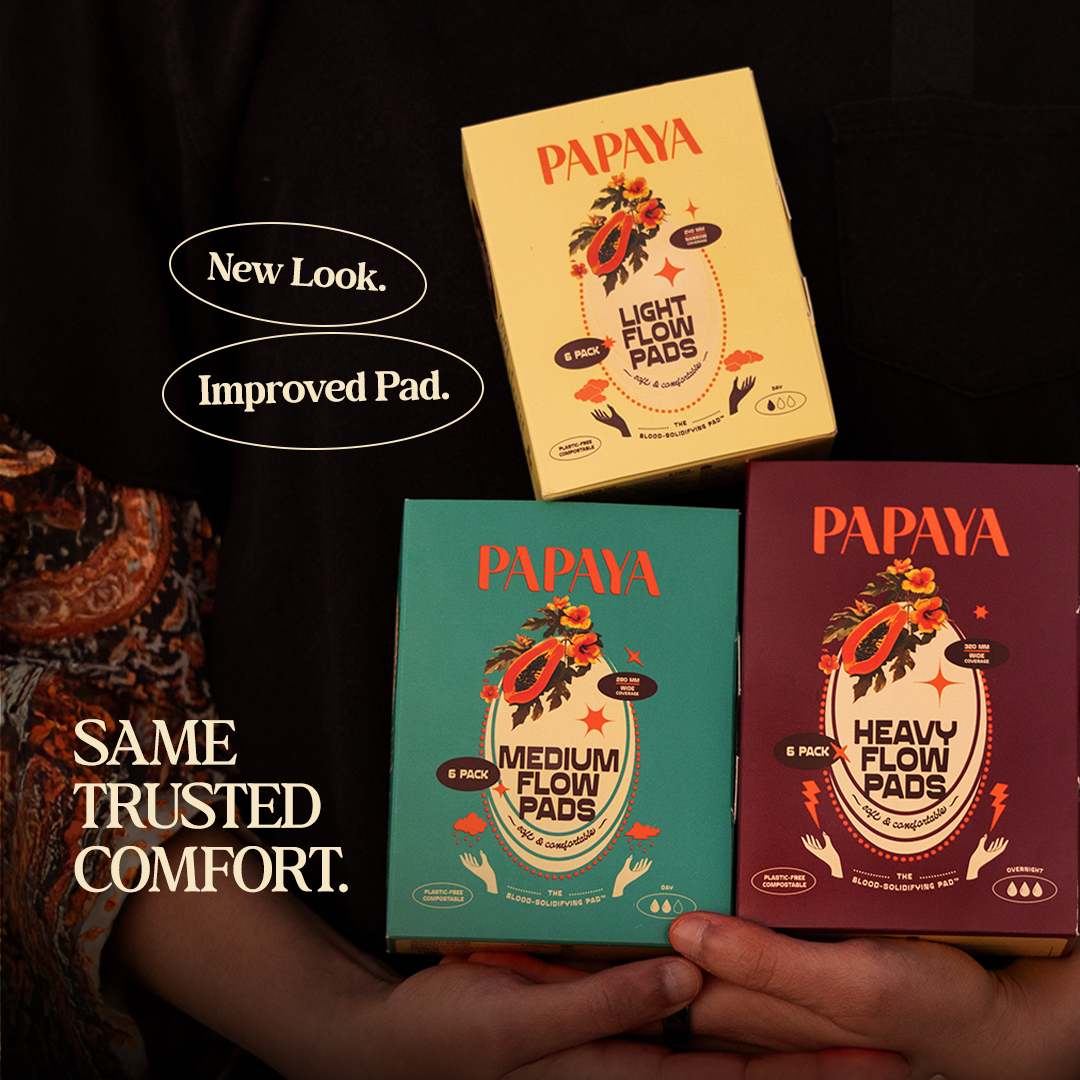
Papaya's construction with organic cotton, cellulose, natural biocoagulant, biodegradable backsheet, no fragrance, no chlorine describes what plastic-free means across a whole product, not just a top sheet.

Choosing these products doesn't mean accepting weaker performance. Papaya pads are built for heavy and overnight flow. The performance comes from biology, not bulk, and the construction leaves nothing behind for the planet to deal with in the year 2600.

Period care has long been treated as a private matter. The environmental footprint of billions of plastic pads discarded every month is a collective one. So is the question of what materials belong in a product worn in intimate contact with the body for years. Both questions are worth asking, and they're not really separate.