×

How subscription works

1
Choose Your Plan

Select the quantity of packs you need each cycle.

2
Select Your Frequency

Set how often you would like them delivered.

3
Save every cycle

Enjoy exclusive savings on every subscription order.

4
Automated delivery

Your packs arrive at your doorstep, right when you need them.

5
Pause or cancel anytime

You will be charged automatically each month but you're in control, always.

×
10% OFF!
Say hello to your new favorite pad. Sign up and get 10% off your first order! Join our community <3
+91
Join Papaya!
×
FIRST10!
Use this code at checkout!
Copy coupon code
The Hidden Environmental Cost of Disposable Pads – Papaya Blood-Solidifying Pads Skip to content

The Hidden Environmental Cost of Disposable Pads

Every month, hundreds of millions of people reach for a sanitary pad. It gets used, discarded, replaced. Most people never stop to consider where it goes after that, or what it was made of in the first place.

The Scale of the Problem 

A person who menstruates will use somewhere between 5,000 and 15,000 pads or tampons over a lifetime. Globally, roughly 45 billion disposable menstrual products get discarded every year.

Most end up in landfill. Some get flushed despite the instructions on the packet, where they contribute to sewer blockages and eventually ocean plastic contamination. Very few get recycled, because the composite, multi-material construction of most pads makes them hard to process through standard recycling streams.

What's Actually in a Conventional Pad

A standard disposable pad contains synthetic polymers and petroleum-derived plastics like polyethylene and polypropylene in the top sheet, backsheet, and wings. These don't biodegrade and can sit in landfill for 500 to 800 years.

The absorbent core usually combines wood pulp with superabsorbent polymers, synthetic crystals, and sometimes a plastic film interlayer. The adhesive strips are synthetic polymer hotmelts. Each pad is individually wrapped in polyethylene film, then packed into a plastic outer bag.

The generic pad is close to 90% plastic by composition. It touches your body for a few hours and then takes centuries to go away.

Why "Biodegradable" Claims Need Scrutiny 

A growing number of pad brands have introduced products labelled "biodegradable" or "eco-friendly." Those claims deserve a closer read.

True biodegradation in landfill conditions needs oxygen, moisture, and microbial activity. Most landfill environments are anaerobic, because material gets compacted and covered quickly. A product that biodegrades under ideal compost conditions may barely decompose at all in an actual landfill.

Many "eco" pads also replace only the synthetic top sheet with a plant-based material, while keeping a polyethylene backsheet and synthetic core components. The overall plastic content ends up only marginally different from a conventional pad.

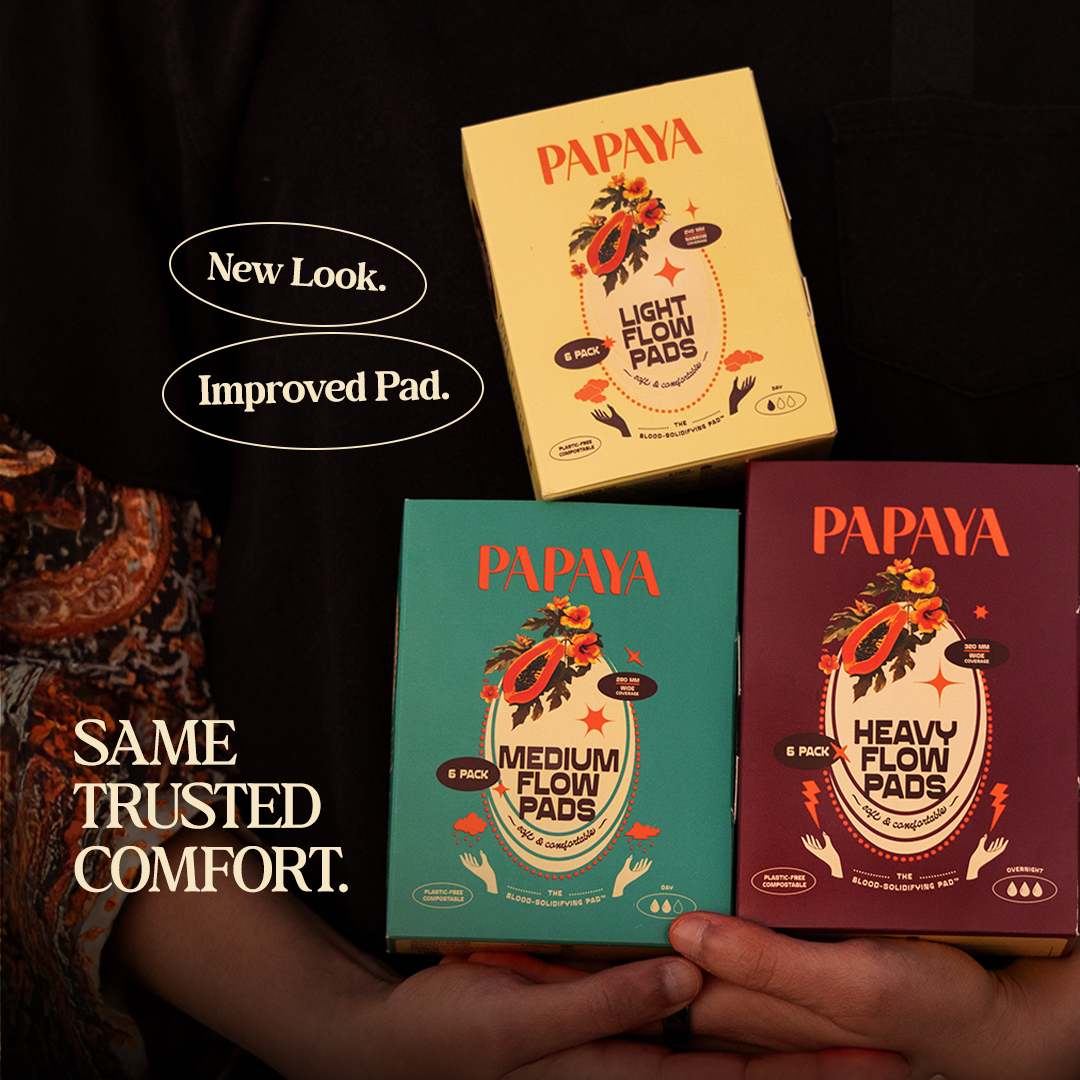
Papaya took a different approach. Plastic in period products carries an environmental cost, but it also exposes the people wearing it to toxins, chemicals, and microplastics directly. Papaya's pads have no plastic in any layer. The top sheet is organic cotton and cellulose, the core runs on a patented natural biocoagulant, and the base is a biodegradable backsheet. Packaging, primary and secondary, is fully paper-based. The pads break down in roughly 180 to 240 days under composting conditions, and they also break down in landfill settings, so they don't need specific conditions to decompose fully. That mattered because most waste never reaches an industrial composting facility. Papaya designed the pad to degrade wherever it ends up, including buried in soil.

What actually cuts environmental impact is a combination of genuinely higher bio-based content across every layer, less overall material per pad, responsibly sourced inputs, minimal packaging, and transparency about the product's lifecycle. Papaya's construction covers all of these, and the company publishes what the pad is made of rather than leaning on vague sustainability language.

The period product industry generates billions of units of composite plastic waste every year. Better material choices are part of the fix. They start with knowing what's actually in the products on the shelf.

Previous Post Next Post