×

How subscription works

1
Choose Your Plan

Select the quantity of packs you need each cycle.

2
Select Your Frequency

Set how often you would like them delivered.

3
Save every cycle

Enjoy exclusive savings on every subscription order.

4
Automated delivery

Your packs arrive at your doorstep, right when you need them.

5
Pause or cancel anytime

You will be charged automatically each month but you're in control, always.

×
10% OFF!
Say hello to your new favorite pad. Sign up and get 10% off your first order! Join our community <3
+91
Join Papaya!
×
FIRST10!
Use this code at checkout!
Copy coupon code
How Leak-Proof Pads Actually Work – Papaya Blood-Solidifying Pads Skip to content
How Leak-Proof Pads Actually Work

How Leak-Proof Pads Actually Work

Leak-proof sounds like a simple claim. It isn't. Leaks fail for more than one reason, and a pad that solves one failure mode while ignoring the others will still let you down.

How Leaks Happen

Period pads fail in three distinct ways, and each needs a different fix.

Saturation overflow is the obvious one: the pad runs out of capacity. Fluid arrives faster than the core can absorb it, or the core fills up and the rest has nowhere to go. This is the failure mode most pad marketing talks about. It's also less common than people assume, at least for anyone changing pads at reasonable intervals. The other two failure modes are usually behind the leaks that catch people off guard.

Rewet and migration is subtler. The pad hasn't hit its total capacity, but saturated absorbent material releases fluid under compression the way a soaked sponge releases water when squeezed. And this compression is your ordinary everyday things like sitting, bending, the pressure of clothing. That fluid migrates toward the pad's edges and leaks from there. Rewet leaks tend to come from the sides rather than the front or back, and can happen well before the pad is technically full. They're strongly associated with cores that lose structural integrity once saturated.

Positional failure means the pad moved. Coverage ends up somewhere other than where the flow is, and fluid reaches unprotected fabric. Thick, stiff pads that don't conform to the body cause this. So do wings that come unstuck, weak adhesive, or activity that shifts the pad out of place.


The Core

The core is the single most consequential choice in preventing rewet and migration.

Conventional fluff-pulp and SAPs cores absorb by soaking fluid into a matrix, where the liquid is held. Apply pressure and that liquid gets expressed back out. The more the pad is used, the less surface tension capacity the matrix has left, and the problem compounds.

Another problem with SAPs is that they plastic, non-biodegradable, and sitting in the absorbent layer of a product worn against intimate skin for hours means exposure to microplastics and synthetic chemicals over an extended period.

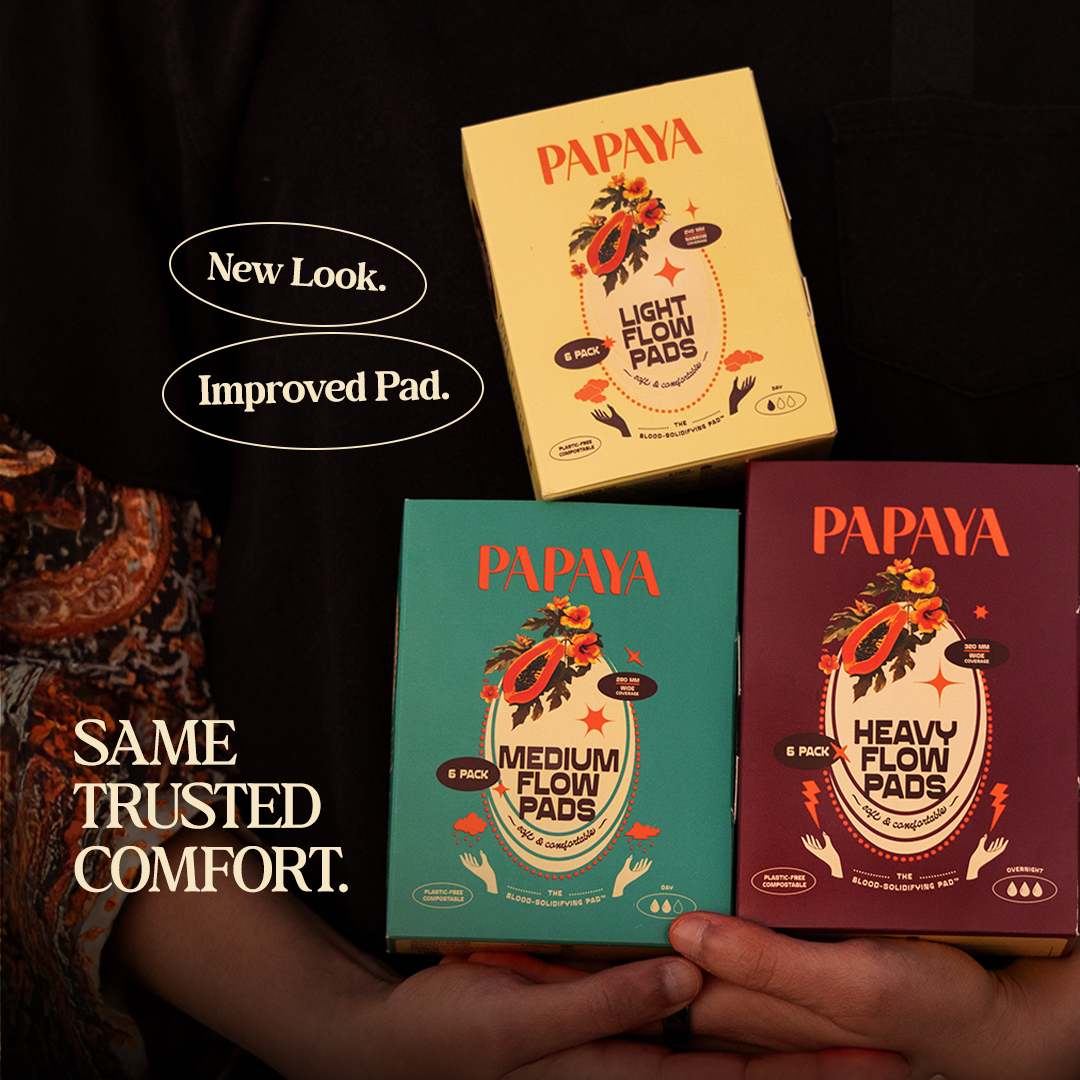
At Papaya we had a problem with absorption. The core technology for a pad had remained unchanged for 100s of years. That changed with Papaya pads. Our pad’s core runs on a patented biocoagulant that uses blood's own clotting mechanism to deal with the flow instead. Blood entering the core doesn't just get absorbed, it solidifies into a stable structure. That's not fluid held loosely between fibres; it's blood that has changed state. Compressing a pad with clotted blood inside doesn't force liquid out the way compressing a wet sponge does. The clot holds regardless of sitting, movement, or pressure.

This is also how Papaya avoids plastic in the pad body altogether. Because the core works through coagulation rather than absorption, there's no need for SAPs, and combined with an organic, biodegradable top and back sheet, the pad ends up fully plastic free. The biocoagulant reaches fluid-locking comparable to SAPs through natural chemistry instead of synthetic polymer.

The Distribution Layer 

Good core technology doesn't help much if the core isn't used efficiently. Fluid tends to pool in the centre, saturating that zone while the rest of the pad sits dry and unused. Front and back leaks usually trace back to this: the centre floods and fluid runs off the edge instead of spreading sideways into unused material.

A proper acquisition and distribution layer sits between the top sheet and the core, moving fluid quickly and spreading it laterally before it settles, so the entire core area gets used.

The Top Sheet 

Leaks also happen at the surface, not because the core is full but because flow rate temporarily outpaces how fast the top sheet can pass fluid through. On heavy days flow can arrive suddenly and in volume. A slow top sheet lets fluid pool and run to the edges before it's even absorbed. Pads with an organic cotton and cellulose top sheet are open enough in structure to move fluid through quickly, which helps both comfort and leak prevention.

The Backsheet

The bottom layer is the last line of defence. Most pads use a solid polyethylene film, effective but plastic through and through. Papaya replaced it with a plant-based biodegradable backsheet that holds the same leak protection without polyethylene. So its the same barrier, minus the material that sits in a landfill for centuries.

Wings 

Positional failure comes down to the attachment mechanism. Wings that fold under the underwear gusset and adhere from below resist shifting better than an adhesive strip alone. Wings that are too short don't wrap around properly. Weak adhesive comes unstuck. Stiff wings don't fold cleanly. Good wing design means secure, flexible attachment that holds through movement.

Why Leak-Proof Claims Vary

A pad that improves capacity without addressing rewet still leaks on heavy days. A pad with a strong core but poor distribution leaks front and back. A pad with great absorption and weak wings leaks when you move. Leak-proof performance depends on the whole system working together, not any single layer.

When a pad lets you down, the failure mode usually points directly to what needs fixing: saturation, rewet, or position.

Previous Post Next Post