×

How subscription works

1
Choose Your Plan

Select the quantity of packs you need each cycle.

2
Select Your Frequency

Set how often you would like them delivered.

3
Save every cycle

Enjoy exclusive savings on every subscription order.

4
Automated delivery

Your packs arrive at your doorstep, right when you need them.

5
Pause or cancel anytime

You will be charged automatically each month but you're in control, always.

×
10% OFF!
Say hello to your new favorite pad. Sign up and get 10% off your first order! Join our community <3
+91
Join Papaya!
×
FIRST10!
Use this code at checkout!
Copy coupon code
Period Care Has Changed Less Than Smartphones – Papaya Blood-Solidifying Pads Skip to content

Period Care Has Changed Less Than Smartphones

Think about everything that's changed in the last thirty years. The phone in your pocket has more computing power than a 1990s supercomputer. The car you drive carries more sensors than a space shuttle. Medicine has been reshaped by genomics, imaging, and targeted therapies that were science fiction a generation ago.

Now think about the sanitary pad in your bathroom cabinet.

It has a sticky strip instead of a belt. That's about it.

The basic design of a disposable menstrual pad, absorbent material sandwiched between a top sheet and a plastic backsheet has stayed largely unchanged since the 1970s. An industry serving roughly 1.8 billion people globally every month has moved at a crawl. The reasons aren't flattering.

A Market that was Ignored

Period care has been treated as a niche market despite its global scale, for reasons tangled up in long-standing attitudes about menstruation: private, not discussed in polite company, and certainly not in boardrooms or engineering departments.

The people designing most consumer products through most of the twentieth century were predominantly men with no direct experience of the products they were making. The people using them had little cultural permission to complain loudly or demand better. The feedback loop between user experience and product development simply didn't exist.

Pads kept being made with the same materials and the same basic construction because no one with power in the industry was asking whether they could be better.

The Regulatory Grey Zone

Period products occupy an ambiguous category in most countries, somewhere between consumer goods and medical devices depending on jurisdiction.

Cosmetic products require ingredient disclosure. Medical devices require clinical evidence of safety. Period products have often required neither in full. Without mandatory ingredient labelling, consumers couldn't know what was in their products, let alone compare them meaningfully.

If shoppers can't see the difference between products, and manufacturers aren't required to explain it, innovation doesn't reach the market.

The "Good Enough" Trap

Most mainstream pads work in the basic sense that is they absorb flow and keep clothing clean. Measured against the narrow question "does it leak?", they generally pass. It isn't complicated engineering. It's absorption, the same way it's been done for decades.

That standard leaves out a lot: whether the pad causes skin irritation or rashes, whether the materials are safe for hours of intimate contact, whether plastics and endocrine-disrupting chemicals belong in a product worn against hormonally sensitive tissue, whether the environmental cost of billions of plastic products is acceptable, and whether the experience of wearing one is better or worse than it could be.

When "good enough" is the bar, there's no incentive to invest in materials science or design iteration. And for a long time, the people using these products had no real platform to say what "better" should look like.

What's Finally Changing?

The last decade has brought real movement, driven by two forces.

Consumer voice. Social media gave people with periods a way to talk about their experiences that bypassed the traditional silence around menstruation. Pad rashes, reactions to synthetic fragrance, plastic waste, endocrine-disrupting chemicals, all these conversations went mainstream, and manufacturers now have to answer questions they used to avoid.

New entrants. Smaller, direct-to-consumer brands entered the market specifically because they saw how much room for improvement there was. Without decades of sunk investment in existing manufacturing processes, these brands could start from "what does this product actually need to do for the person wearing it?" instead of "how do we tweak what we already make?"

Papaya: A Case Study in What's Possible

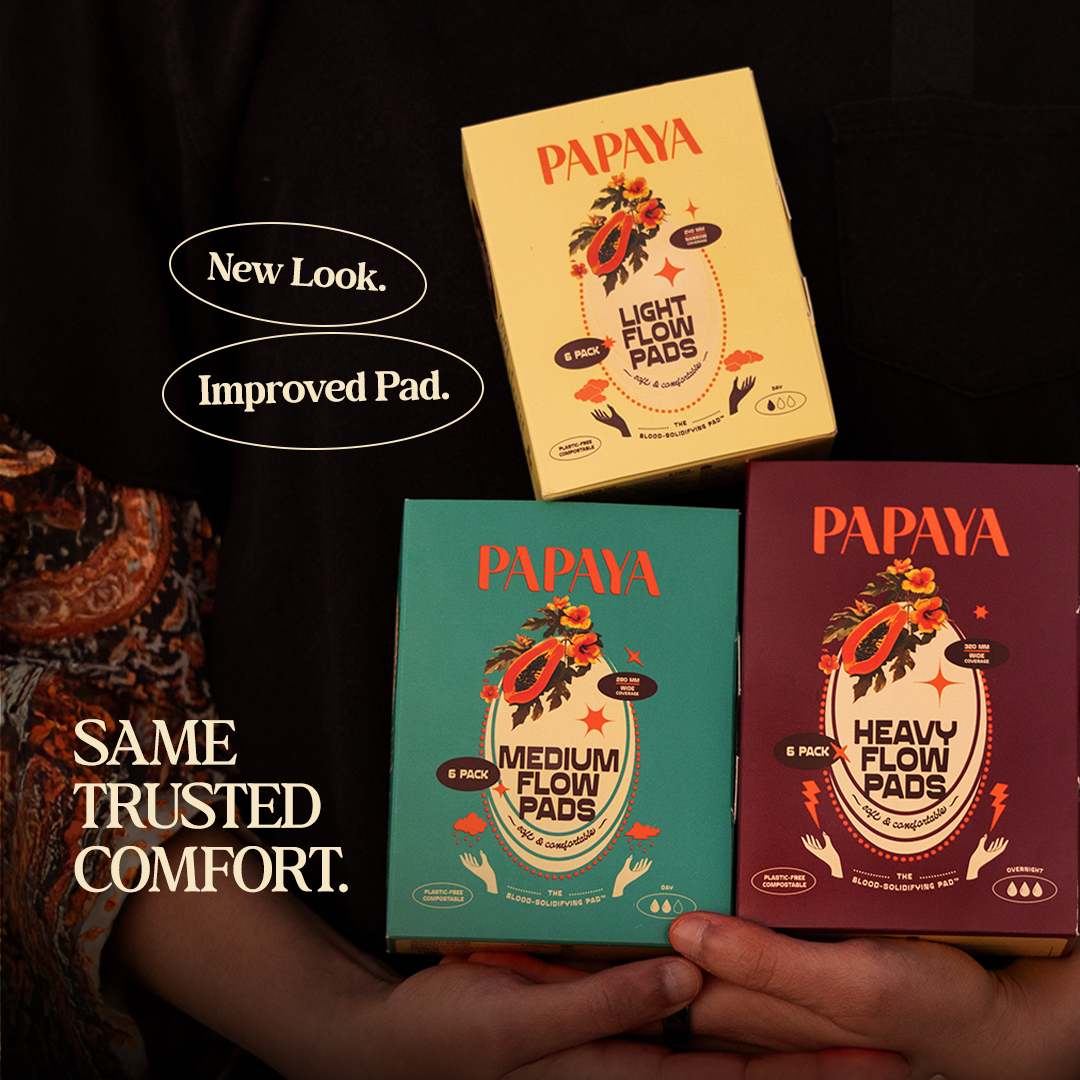
Papaya treats period care as an engineering problem worth solving properly, and as a women's health issue rather than a hygiene afterthought.

The starting point was replacing the outdated absorption mechanism. Papaya built a

biocoagulant,  a patented, plant-derived material that causes menstrual blood to clot inside the pad the same way the body stops a bleed. Absorbed blood forms a stable clot instead of sitting as free liquid in a fibre matrix. The pad surface stays dry to the touch, the clot doesn't rewet under pressure, and none of it requires SAPs, plastics, or synthetic polymer chemistry to hold large volumes of fluid. The result is a pad that's easier on skin and lighter on the planet.

The rest of the construction follows the same logic: organic cotton and cellulose for the top sheet instead of polypropylene, the biocoagulant core instead of plastic-laced pulp, a biodegradable backsheet instead of polyethylene, no fragrance, no chlorine, no endocrine-disrupting chemicals. The pads break down in 180 to 240 days, including in landfill conditions rather than only in industrial composting facilities, because that's where most period product waste actually ends up.

This isn't a marginal tweak on a conventional pad. It's a different starting question about what the product is and what it should be made of, one that arguably should have been asked decades ago.


What this Means for Buyers Today

The products on pharmacy shelves represent the slow-moving mainstream. Better options exist now. If your phone has changed beyond recognition in the last ten years, it's worth asking why your pad hasn't, and whether "good enough" should still be the standard.